|

The
New Generation Video Game Computer System.
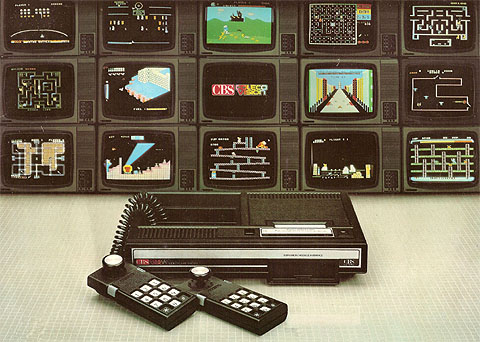
CBS ColecoVision Video Game /
Home Computer System - Expansion Module Interface.
CBS ColecoVision Ordinateur Multi-Services - Interface Pour Modules
Additionnels.
Arcade
Quality Sound And Graphics.
CBS ColecoVision has the
power and capability to produce the superb sound and graphics only
experienced before
in genuine electronic arcade games.
Good sound and graphics are essential features which make arcade games so
challenging and enjoyable to play.
Now these outstanding features are available in your own home with CBS
ColecoVision Video Game Computer System.
Top quality on-screen detail
is made possible through the powerful microchips inside the CBS
ColecoVision Console;
the 32 K Rom Micro processor is more powerful than any other video game
system and more powerful than most
basic home computers.
A Wide Range Of Super-Charged Games.
CBS ColecoVision has lot
of challenging game cartridges which are faithful copies of the arcade
favourites.
The games are so close to the arcade originals in sound, graphics and
gameplay because each cartridge containsa super-charged' chip, ranging from 8K Rom to 16K Rom.
(Donkey Kong
cartridge) with Turbo and Zaxxon cartridges
containing the ultra powerful 24K Rom chips.
Couple the power of the
game cartridges with the power of the CBS ColecoVision console and you
have the realism,
detail and challenge in every cartridge which will test the most skillful
video game expert.
CBS ColecoVision have already
tested thousands of players because they are exclusive games developed by
the
arcade game experts for the original arcade games.
To get the best from each
game you need fast, responsive easy to handle controllers.
The CBS ColecoVision console has controllers which include an 8 direction,
fingertip control joystick,
2 independent fire / action buttons and a 12 digit push button keyboard for
game selection.
Expansion Capability For The Future.
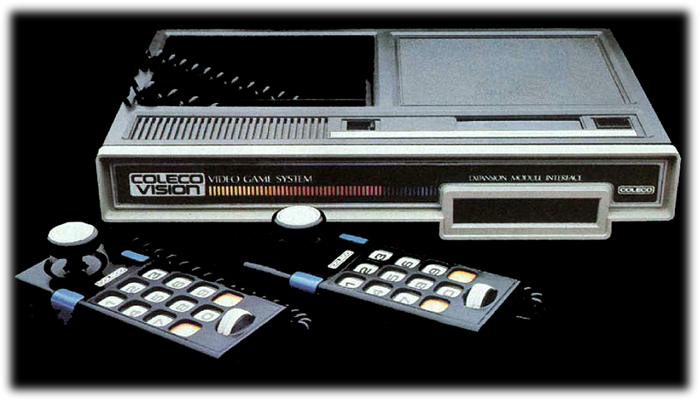
The Expansion Module
interface is a unique feature for the CBS ColecoVision console: It allows
the console to be
expanded to perform other uses.
At this time two expansion Modules are available with the third, a
powerful home computer, close to completion.
Expansion Module No. 1
allows you to play all Atari VCS compatible cartridges on the CBS
ColecoVison console.
This unique adapter gives access to the widest range of video game
cartridges available.
Expansion Module No. 2 is a
driving unit which includes steering wheel, dashboard unit and accelerator
pedal, and
comes with the Turbo video game cartridge.
Expansion Module No. 3 is a
sophisticated Home Computer keyboard unit which harnesses the power of the
CBS ColecoVision game console (32K Rom;16K Ram) and converts into a
powerful home computer.
These Expansion Modules are
just the beginning; through the unique Expansion Module Interface it is
possible
to expand the CBS ColecoVision console to fulfil many future needs.
|
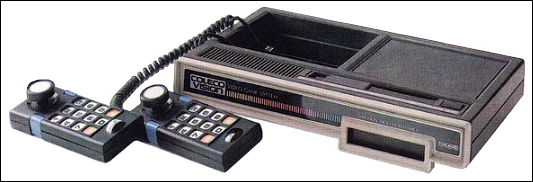
The whole adventure began above.
The very first prototype.
Note the spinners, the blue
push buttons, on/off
and reset (horizontal).
The  and # are presented in
orange color. and # are presented in
orange color. |
Colecovision was in the 1982 until around 1985 the biggest
gaming console ever.
ColecoVision was an Arcade machine just for your home, designed by Texas
Instruments and manufactured both in USA., Hong Kong and Taiwan.
The Colecovision is essentially a stripped MSX1 and very close to
SpectraVideo 318.
ColecoVision is related to all home computers and consoles with the
environment around Z80 and the graphic chip 9928.
ColecoVision has a cartridge slot, 16 kb video RAM, up to 32kb ROM and 1kb
RAM.
So games written for the colecovision could easily be ported to the MSX, but
the other way around proves to be more difficult (but is certainly
possible as well).
Atari 2600, Mattel and
Philips do not have the same high resolution graphics like
ColecoVision.
Intellivision was even better than Atari 2600, and Atari better
than Philips/Odyssey.
But what was it there could make ColecoVision so popular back in
the 80's ?.
Popular movies at the time was: Scarface, StarWars, WarGames,
Flashdance, Trading Places Jaws 3, Superman 3, Christine, Dirty Harry and
many more.
-But these video games you played on your local Arcade in the early 80's,
for your hard working money,
was so you could play your favorite games like Donkey
Kong, Pac-Man, Pole Position, Qix, Popeye, New Rally-X and maybe Lady Bug.
These games was in that time very popular and the people there played
on these machines was completly obsessed.
You was "a kind of obsessed", -maybe you could make a record, and
then get your initials on the screen for the rest of the day, or even a
kind of "forever".
There was earned big money up around the 80's on these
Arcade machines, just like the old fasion
slot machines.
and the Pinballs.
A big part of these arcade machines was build up around the CPU Z80A,
and the same CPU chip is build inside of the ColecoVision.
Zilog's popular CPU Z80A, was an 8 bit prossesor that saw the
day of light back in 1976, with around 4 MHz. of speed.
Z80A are close to Intel 8080/85.
A good thing was that the Z80A could generete own RAM signals.
The first
Z80 = 2,5 mHz. Second version Z80 A = 4 mHz. Third version Z80 B = 6 mHz.
and Z80 H = 8 mHz.
The popular Hitachi HD 64180 was also close to Z80A, and had even
MMU.
A coin-up for an arcade machine fill
around 40 x 40 cm.
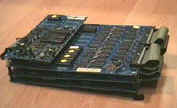
E.g.: "Moon Patrol" 3
pieces of a PCB: 37 x 42 cm.
+1 piece of: 37 x 16 cm.
This game PCB is filled with chips from inside an Arcade machine way back in 1985.
But a cartridge for ColecoVision is only around 10 x 8 cm. and
include a PCB with only 2 or 3 chips.
Remember an arcade machine could have the same CPU, for data, but
it could also have it for working sound.
Arcade games had
also a very large and a different way of chipset to be able to run such a
game of this size.
So limited chips for a ColecoVision game had therefore some limitation in the gameplay for ColecoVision
back in the day compared to today.
Even on the ColecoVision game box was a textnote: "Just
like the real arcade game" Well, you most realize that
it was a different game you played,
but many are close to.
ColecoVision and the Adam Family Computer had the core and was close to SpectraVision 318, and
both was the precursor for the later
MSX adventure.
Why are they so close and yet not anyway, since MSX, as we know came
straight after.
SpectraVideo 318 was an unfinished MSX home computer like ColecoVision and
the ADAM Family Computer System.
The differents was Coleco's own restrictions.
They made ColecoVision as cheap as possible, so no easy multicolor
or vector, and
flicker in the games was a big problem.
Coleco's
gamedesigners was reminded to remove
all unnecessary things that could prevent the game to fill to much.
Characters og backgrounds was simple in many games, and the logical gameplay was
sometime
changed.
ColecoVision could not in many cases get close to an arcade machine, neither
on memory, 80's resolution and colors.
A ColecoVision Graphic chip could only handle 15 colors, 1 transparent and
had in no way a scrool or vector generator built in.
Also the design inside on the PCB, components, and the way the console are
built are a limitation in itself.
Coleco's own graphic designers was not even able to program a nice smooth
scroll for Colecovision.
But it could the people from the 3rd Party companies like Imagic and AtariSoft, with their games
like:
"Nova Blast", "Defender" and "Moon Patrol".
Differents in many games design was that, allmost all the
arcade machines
had a vertical monitor,
while a tv screen is horizontally.
So it was a big work for the graphical designers at Coleco to redesign it
all from scratch, and there was no time for a Coleco employer to take a break
and think deeper.
Coleco released a lot of games, so they decided in 1983 to outsource some of them to
other companies.
A cartridge for ColecoVision was in the 80's up to 32 K. ROM and in the
80's was those chips very very expensive.
Today
128 K. for the first homebrew Pac-Man Collection, and
256 K for Dragon's Lair and now even up to 512 K for Wizard Of Wor is not uncommon today.
MegaCart1 from Opcode Games can provide up to more than 1 mb., and the new
one MegaCart2 can even handle a Savegame feature.
But only
in connection with the Opcode Super Game Module 1 and 2, or the Phoenix
VGS.
ColecoVision is today more
powerful than ever.
You still have your old 80's ColecoVision -if
it still works.
But you can now add a Super Game Module with extra RAM and one more Sound
chip.
You can also add an very avanced AtariMax SD Cartridge with a SD card reader.
You can also add a F18A Graphic Card with VGA out, and newest MK II can handle HDMI.
Alternatively there is also a new
TMS RGB
version.
New is also Super games that can store settings and save high-scores in
the cartridge without batteries.
Others have made Pause, Slowmotion, LED, Surround new Power supply and
other things.
After Coleco say stop for further games in 1984 and the game market general in U.S. failed in mid 80's, was
there still many
unreleased ColecoVision games on the market.
Many games was hastily completed, and the last hit the market in 1986, but
the screen says 1984.
Konami Industry has short after a big sale outside the U.S. for the MSX platform.
Homebrewers in USA, Brazil, Mexico, France, Canada and other countries can now, -thank god, converted
many of these MSX games
so they can be played on ColecoVision today.
Companys like Konami, Namco and Activision is
still around, but not our beloved ColecoVision, it will only
die slow.
The problem with our ColecoVisions is the lifetime, it's limited by the range of components
which many of them have left the world.
Fortunately, more emulators have been made
and new consoles like the ADAM+ and CV-NUC+ are on the way.
And remember there will still be produced ColecoVision games even today.
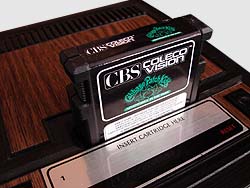

This is one of the
original Coleco Brand from the former company Coleco Inc.
The Brand is not the oldest.

Games and ColecoVision consoles in Europe was licensed under CBS Electronics.
The common name was ColecoVision.
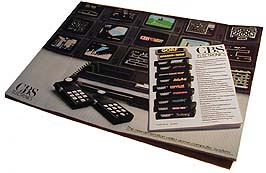
Promoted advertising: CBS
ColecoVision Europe.
|
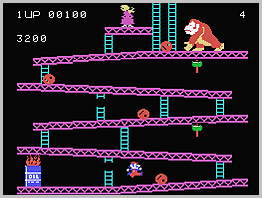 |
When Coleco
Industries introduced their
ColecoVision in U.S.A. in August 1982,
was it with one of the most popular game the world known, namely Donkey Kong.
One of
Nintendo's biggest hit ever. |
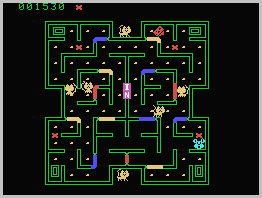 |
In Denmark and
large parts of Europe and Scandinavia
was ColecoVision not necessarily
with Donkey Kong.
It was also released with the game
Mouse Trap, a Pac-cheese look-a-like game was
included instead.
And in Denmark an Italy was Mouse Trap included. |
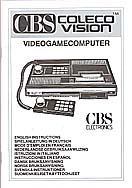 |
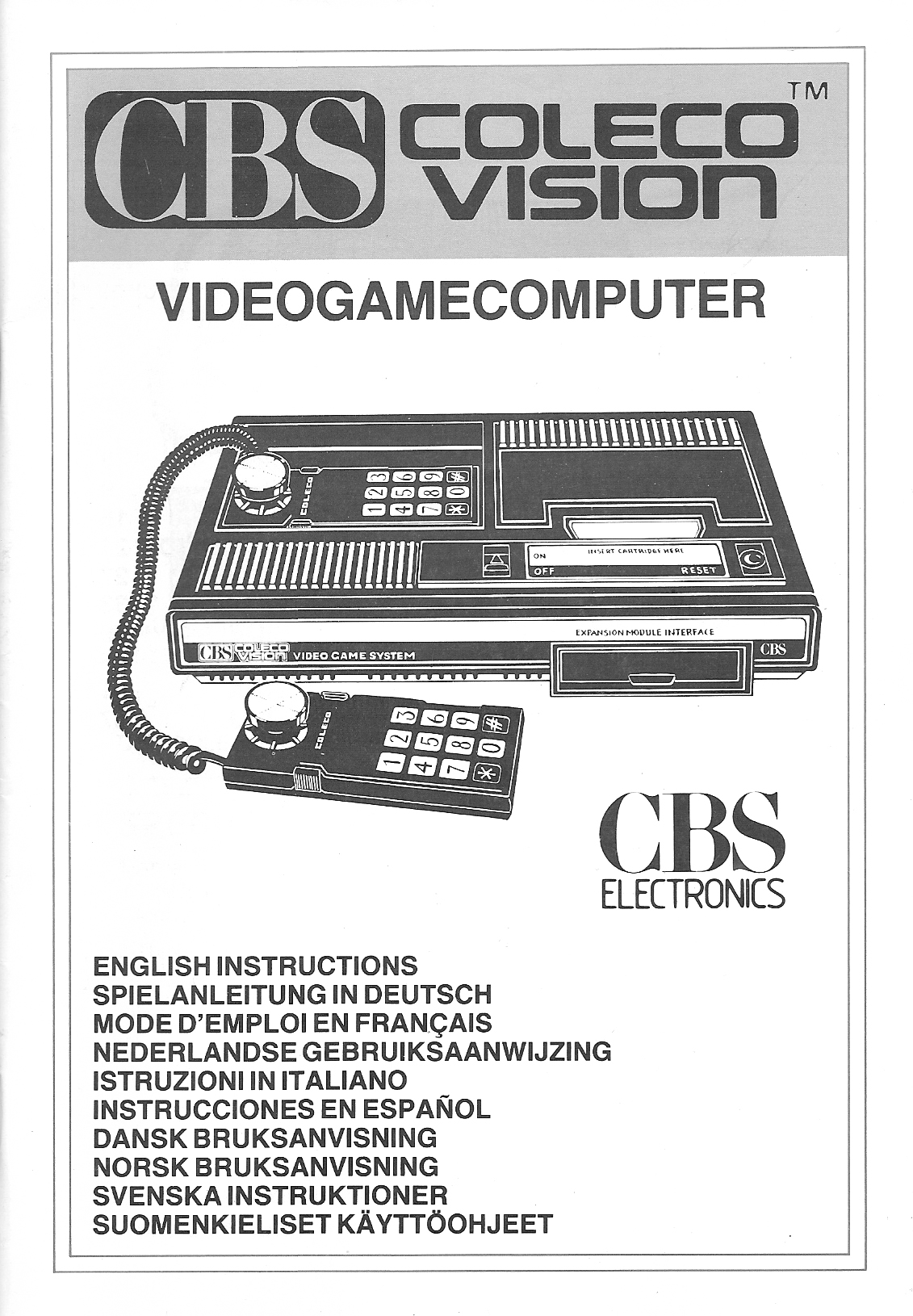
The Official Instructions book for Europe.
The Official Instructions book are including 10 languages.
Engelish
Deutsch
Français
Nederlandse
Italiano
Español
Dansk
Norsk
Svenska
Suomenkieliset |
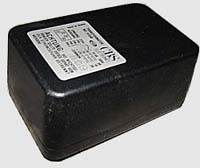 |
The originally power supply was
big and heavy as a rock.
110-130 V ~ 19 VA 60 Hz. NTSC
Or:
220-240 V ~ 19 VA 50 Hz. PAL
| pin 1 |
+ 5V |
.9A |
| Pin 2 |
- 5V |
.1A |
| Pin 3 |
+ 12V |
.3A |
| Pin 4 |
Common |
|
It's said that the 60 Hz. U.S. version of
the power supply easily can break.
Maybe because they have a plug in version.
In relation to the EU and maybe Canada do the U.S. power supply
not have a lead at each end of the power supply.
Other
Some of the first games released for
ColecoVision was:
Cosmic
Avenger - Donkey Kong - Mouse Trap - Lady Bug - Smurf - Venture -
Turbo -
Zaxxon - Space Panic - Carnival - Gorf - Looping - Pepper II - Space
Fury. |
|
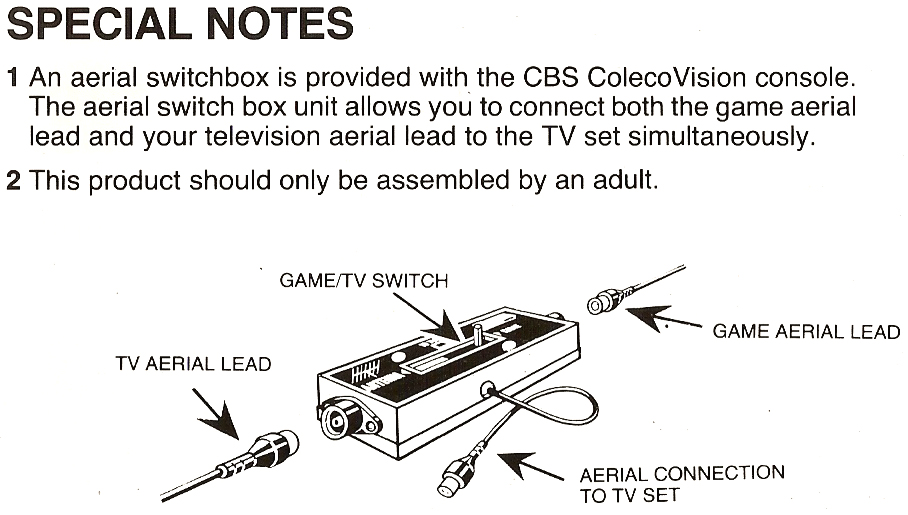
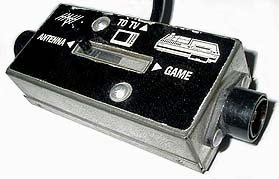
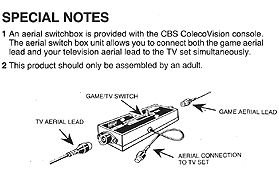
This is the original aerial splitter
For Europe. (DIN).
2 x female and 1 x male. |
 |
 |
|
Originally CBS / ColecoVision Technical 1982 / 83 : |
|
CPU |
Zilog Z80A |
8 Bit |
1 K System RAM |
|
Resolution |
Graphic mode 1 |
256H x 192V |
|
Adress-system |
16 Bit |
|
Speed |
3.58 MHz for NTSC and 4.43 for PAL |
|
Bios RAM |
8 K RAM |
|
Video RAM |
16 K RAM |
(8x4116) or (8x8326) |
|
Graphic Processor,
8 bit. 10,7 mhz. |
TMS9918A 60 Hz. NTSC. No RGB.
Only Video Out. |
TMS 9929A 50 Hz. with Y Pb Pr
for RGB encoding.
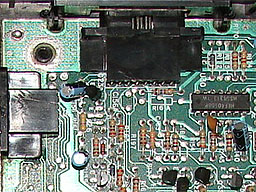
For PAL up to 313 lines per frame. French version has RGB output
via Scart connector. |
|
Sprites |
up to 32 |
Simulated, max 2 moving sprites per
scanlines, flickering. |
|
Colors |
15+1 transparent. |
 |
|
Text on screen |
36 characters a 24 lines, and 80
characters for the ADAM Computer with a Monitor and a Hardware
card. |
|
Soundchip |
Internal, SN76489AN |
3 channels, 5 oktavian and 1 white noise,
Dual Mono |
|
Cartridge ROM |
8 K -16 K -24 K -32 K as standard. |
|
Output signal |
2 channels RF Coaxial / F - Connector
for U.S., and 2 channels HF Coaxial / DIN Connector for Europe.
Direct RGB Scart
connector for
France. |
|
|
|
|
|
|
The ColeVision console had a 12 seconds delay that irritated many
people in USA, and people were irritated about having to wait so long for
a game to start up.
The real reason behind the 12 seconds delay is a
loop in the ColecoVision Bios, the delay was purely intentional.
Eric Bromley at Coleco felt that 12 seconds was appropriate for the copyright.
Some
companies like Parker Brothers, Activision, Micro Fun and allmost all newer
3rd party companies avoided this
delay by simply bypassing it in the Bios.
In Denmark, Australia and other contries in
Europe we don't have the 12 seconds delay, only around
4 seconds.
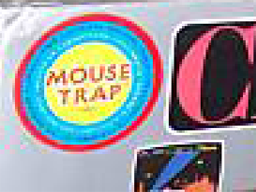
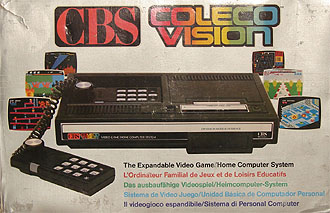
On the right do you see my very own box from 1983 / 84.
I found the box far behind in my storage room, which I also found the box for the
Roller controller.
The Mouse Trap sticker up left is fallen of over the time.
On the picture left, you'll see where the label would have to sit.
When and if I find the receipt on the purchase of my CBS ColecoVision,
will also that be posted.
The receipt was finally found in November, 2020.
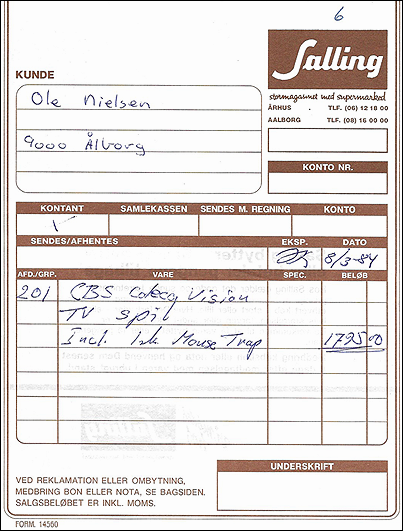
And now uploaded to ColecoVision.dk in July
2022.
We have it in Denmark late 1983 for a price of 2.495,- DKR.
Few months later in February 1984 then the price was reduced to 1.795,-
DKR.
And there I struck.
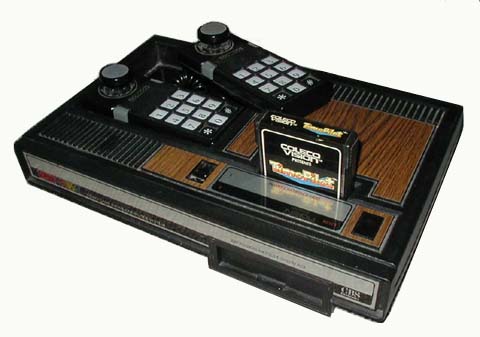
This is my very own and 1st. CBS
ColecoVision on this picture.
The adhesive wood effect (Hazelnut) is placed by me in 1984.
And was inspired from the 70's Atari VCS 2600 and the 80's Intellivision.
My very first and brand new ColecoVision was a CBS revision printed 1983 with a U.S. board
inside.
Then after, 3 ColecoVisions in various revisions, and finally end up with the
French version.
So my 5th board is a French REV. B # 91209 from 1983.
And my 6th French ColecoVision board from October 2018 is a REV ?.
It's the best ColecoVision on the market at all. ( 9929A + RGB ).
The adhesive wood effect is still on my ColecoVision, I just change the
upper half plastic case every time I got a new ColecoVision.
Many out there have tried to emulate it with varying results.
But this one, is the one and only.
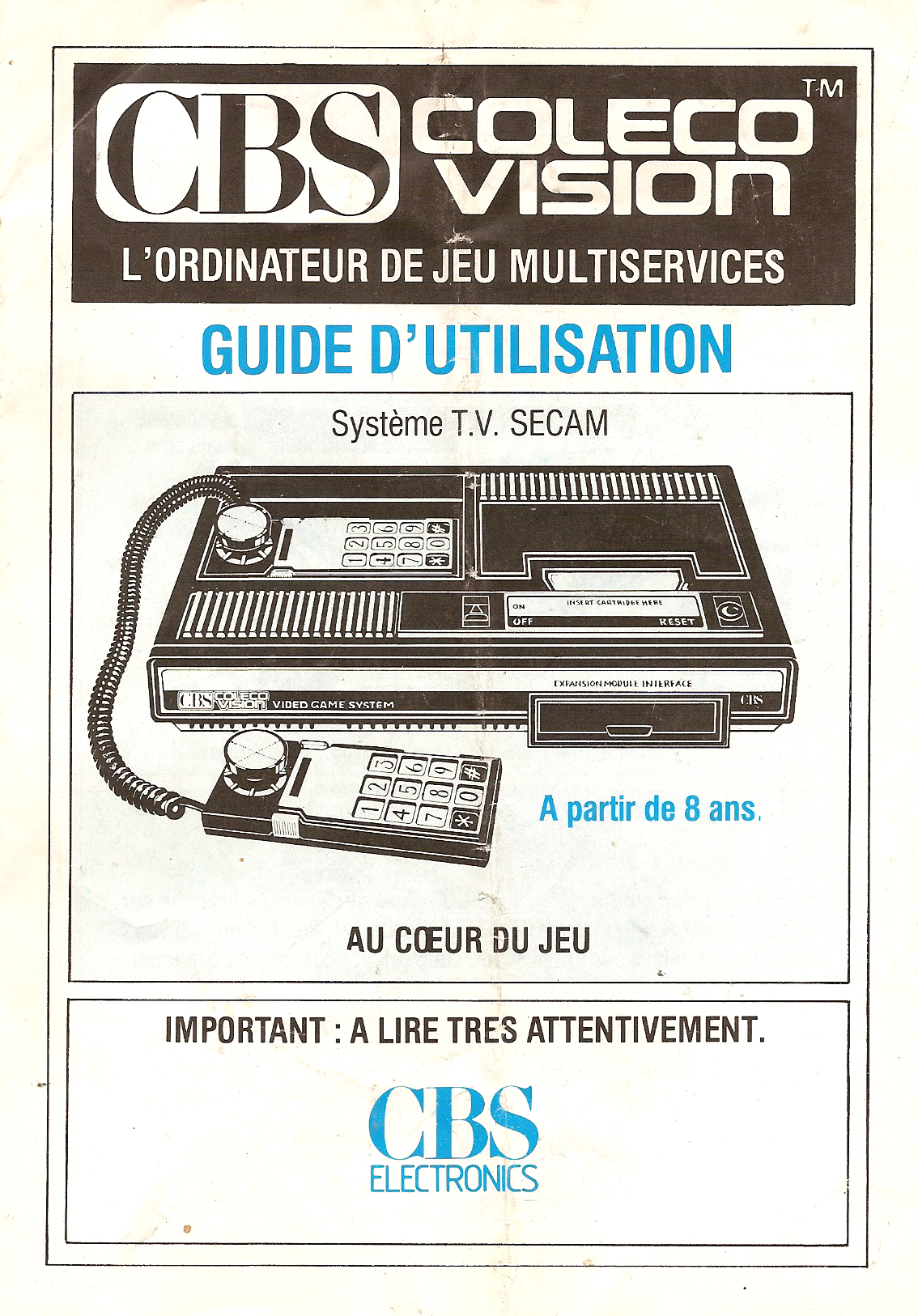
The French version.
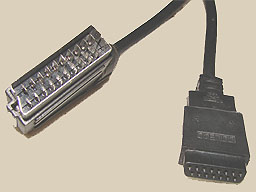
Official Coleco
Péritel or
SCART TV cable, allows you to get the
better quality of
sound and picture through the RGB signal.
It also allows you to connect the console to any CRT, LCD or old plasma TV, as
long as it has a SCART connector.
Scart
avoiding much more interference or noise, typical of the RF-Antenna / RCA / F lead
connection.
Very few CBS Colecovision consoles were sold including this SCART lead,
because in that time the
SCART
Connection had not become a standard on ColecoVision yet.
Scart was not known was not known in wider circles in U.S. at that time.
The French standard was originally designed in the 70s, under the name
Péritel.
U.S. call it
EIA interface, and many europeans call it Euro-connector, but Scart
is a kind of common name.
This standard is more than common in Europe than in the rest of the world,
in which commonly used the famous yellow RCA phono plug.
Therefore, these may well become confused about what is AV in Europe and
what is the AV in for example in USA.
The french CBS ColecoVision version with Scart output was the last production and primarily intended
for the French market.
In U.S. and Canada was the production already stopped, but the stock end
was still crowded.
As Coleco sold out of their units were surplus of perhaps some boxes from
the CBS production, therefore, the last consoles sold with different body
content and various manuals, and even with white controllers.
But the French version should be all original.
"This console is
almost 40 years old !
A true collector, very rare in France.
It worked well in the world, around 6 million copies, huge for the time, but it
was sold only six months in France."
|
 |
 |
 |
 |
|
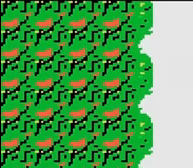
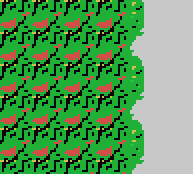
With RF on LCD. |
With RGB on LCD. |
With HDMI on LCD. |
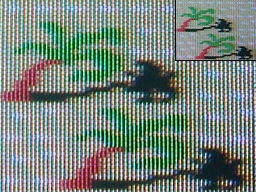
(Left)
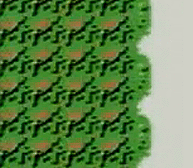
Look at these
Palms in Road Fighter with RGB on a old catode color Tv., it flows
out.
And Bump 'n' Jump with RF on LCD, and with RGB and last, HDMI on LCD. |
Last 7 updates:
February 12, 2023.
August 12, 2022.
July 17, 2022.
June 13, 2021.
August 23, 2020.
October 02, 2018.
September 28, 2018. |